
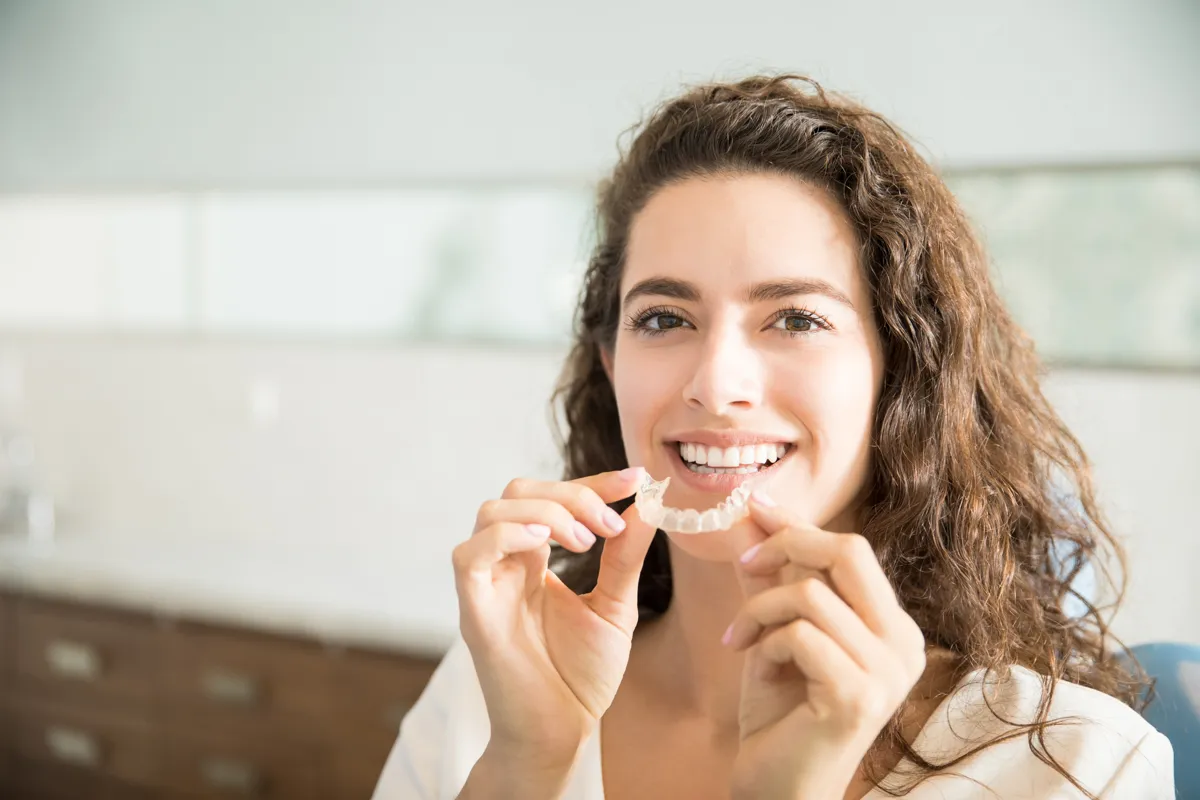
Clear aligner treatment is an orthodontic method that moves the teeth step by step using a series of thin, custom-made plastic trays that are barely visible in the mouth. Each aligner applies a small, planned force to the teeth, and as you move on to the next aligner at set intervals, the teeth gradually approach their target position. This page explains how the method works, who it suits, why daily wear matters so much and how aligners compare with fixed braces.
How do clear aligners work?
Orthodontic tooth movement relies on a light, continuous force applied to a tooth over a long period. This force triggers remodelling in the bone and connective tissue around the tooth: on the side the tooth is moving towards, bone is slowly resorbed, and on the side it leaves behind, new bone forms. Braces deliver this force through brackets and a wire; a clear aligner delivers it through a shell that wraps around the teeth and is shaped a few tenths of a millimetre away from their current position.
Treatment works through a series of aligners rather than a single one. Each aligner in the series differs only very slightly from the previous one. When you put an aligner in, the teeth are pushed in the direction that closes this small gap. Once the teeth have settled into their new position, the aligner feels comfortable and it is time to move to the next one. Aligners are usually changed every one to two weeks; the exact interval is decided by the orthodontist according to how the case is progressing.
Aligners do more than tip teeth forwards or backwards. With careful planning and auxiliary features, more complex movements can also be targeted, such as rotating teeth, extruding or intruding them vertically, and correcting root angulation. How predictable these movements are depends directly on the difficulty of the case and on how consistently the patient wears the aligners.
Examination, records and digital planning
Treatment begins with a standard orthodontic examination. Whether aligners or braces are the right choice cannot be answered before the examination; the problem itself has to be understood first.
1. Clinical examination
The orthodontist assesses the alignment of the teeth, the position of the jaws relative to each other, the bite, the health of the gums and bone, and any decay or old fillings. Signs in the jaw joint such as clicking, pain or limited mouth opening are also noted. Active decay or gum inflammation needs to be treated before orthodontic treatment starts; where necessary, procedures such as fillings are completed before the aligner phase begins.
2. X-rays and photographs
A panoramic X-ray shows the roots, any impacted teeth and the bone level. Where needed, a cephalometric (lateral skull) X-ray is taken to measure the relationship between the jaws. Intraoral and facial photographs are used both for planning and for comparison throughout treatment.
3. Impressions: digital scan or conventional impression
How well the aligners fit depends on the accuracy of the impression. With an intraoral scanner, a three-dimensional model of the teeth is transferred straight to the computer. A conventional impression taken with impression material can also be scanned and used digitally. Which method is used depends on the clinical situation; what matters is that the teeth and the gum line are recorded accurately.
4. The virtual treatment plan
On the three-dimensional model, the path of the teeth from their starting position to the target position is planned stage by stage. At this point the orthodontist decides how far each tooth will move and in what order, whether interproximal reduction (slight reshaping between the teeth) is needed, and where the small bonded features called attachments will be placed. The plan is not an automatic output from software; it is a route map that the orthodontist adjusts with biological limits in mind. The final image on the screen is a goal. Because biological response differs from person to person, actual progress is checked along the way and the plan is updated if needed.
5. Fitting the aligners and follow-up visits
Once the aligners have been produced, the first appointment is spent bonding the attachments and explaining how to wear and look after the aligners. Follow-up visits are usually planned every 6 to 10 weeks. At each visit the orthodontist checks whether the aligner is seating fully on the teeth, whether the teeth are following the plan and how the gums are doing. Because treatment runs over many months, you need to be able to attend these follow-up visits in Ankara for the whole course of treatment.
20 to 22 hours a day: why wear time decides the outcome
The greatest strength of clear aligner treatment is that the aligners are removable; its greatest weakness is exactly the same thing. Braces stay in the mouth all the time and keep working even if you forget about them. An aligner only works while it is in your mouth. That is why aligners are recommended to be worn for 20 to 22 hours a day. The remaining time is for eating, brushing your teeth and cleaning the aligners.
This figure is not arbitrary. Bone remodelling depends on the force being continuous. When an aligner is left out for long stretches during the day, the tooth tends to drift back while the force is absent, and it has to cover the same distance again once the aligner goes back in. As wear time drops, the aligners stop seating fully, the plan and the real situation drift apart, and an additional series of aligners may be needed. This is the most common reason for treatment taking longer than expected.
A few habits that help in daily life:
- Take the aligner out only to eat and to drink anything other than water; brush your teeth after eating and put the aligner straight back in.
- Keep to set mealtimes rather than snacking throughout the day. Every snack adds to the time the aligner spends out of your mouth.
- Drink only plain water with the aligner in. Sugary, acidic or coloured drinks stay in contact with the teeth under the aligner for a long time, which raises the risk of decay and staining.
- Never wrap the aligner in a napkin; when you are out, always put it in its case. Most lost aligners end up in the bin with a napkin from the restaurant table.
- Switching to a new aligner in the evening, just before bed, means the tightness of the first hours falls during sleep.
Who are clear aligners suitable for, and who not?
Clear aligners can now be used in a wide range of cases, but they are not equally suitable for every orthodontic problem. The decision depends on the type of problem and on how reliably the patient will wear the aligners.
Situations where aligners are usually suitable
- Mild to moderate crowding (teeth that are tightly packed or overlapping)
- Gaps between the teeth (diastemas)
- Minor relapse after previous orthodontic treatment
- Some deep bite and open bite cases
- Limited tooth movements to improve alignment before a prosthesis, implant or cosmetic treatment
- Adults and teenagers who can genuinely keep up 20 to 22 hours of daily wear and take responsibility for it
Situations where aligners may not be suitable or may not be enough on their own
- Severe skeletal discrepancies: if the problem comes from the size or position of the jaws rather than the teeth, growth modification is needed in children, and in adults surgically assisted treatment is sometimes required.
- Complex movements such as bringing impacted teeth into the mouth
- Cases involving large changes in root angulation or a great deal of bodily tooth movement
- Uncontrolled gum disease or untreated decay
- Patients who expect that they will not wear the aligners consistently
In growing children, the priority is often to guide jaw development. The options for this age group are explained on the children's orthodontics page.
Clear aligners or braces?
Both methods share the same aim: bringing the teeth into a healthy, balanced bite. Where they differ is in how the force is applied and in what they ask of you in daily life. For bracket types and the details of fixed treatment, see the dental braces page.
| Criterion | Clear aligners | Braces (brackets) |
|---|---|---|
| Visibility | Not noticeable unless someone looks closely | Metal brackets are visible; ceramic brackets are less noticeable |
| Removability | Removed for eating and cleaning | Fixed; stays in the mouth until treatment ends |
| Dependence on the patient | High: the result depends largely on daily wear time | Low: the wire works continuously, apart from extra tasks such as wearing elastics |
| Eating | Few food restrictions, because the aligner is taken out | Hard or sticky foods can break brackets off |
| Oral hygiene | Teeth are brushed as normal; the aligner is cleaned separately | Cleaning around the brackets takes more care and interdental brushes |
| Complex movements | May be limited depending on the case; attachments and auxiliaries widen the range | More predictable control across a wide range of movements |
| Emergencies | If an aligner breaks or is lost, you switch to the previous or next one | A loose bracket or a poking wire may need a visit to the clinic |
| How the first days feel | A few days of pressure and tightness with each new aligner | A few days of tenderness after fitting and adjustments; brackets rubbing against the cheeks |
In some cases the two methods are used one after the other: for example, a difficult movement can be completed with a short phase of fixed treatment and the remaining fine adjustments made with aligners. The biomechanics of the problem decides which route to take as much as aesthetic preference does. For the general framework of orthodontic care, see the orthodontic treatment page.
What are attachments and why are they needed?
Attachments are small tooth-coloured bumps made of composite (filling material) that are bonded to the surface of certain teeth. The aligner grips these bumps and can then apply force to the tooth more effectively. On a smooth tooth surface an aligner can slip; an attachment gives it something to hold on to.
Attachments are an important part of the plan for difficult movements in particular, such as rotating a tooth, extruding it vertically or moving its root. Their shape and position are decided during digital planning, and they are bonded to the teeth using a template tray. The procedure involves lightly preparing the tooth surface with a mild acid and applying a light-cured material; it usually does not require local anaesthetic.
Because attachments are tooth-coloured they do not draw attention, although you can feel them with your tongue when the aligner is out. When treatment ends they are polished off without damaging the tooth surface. If an attachment comes off during treatment it is rebonded at a follow-up visit, so it is helpful to let the clinic know as soon as you notice.
What is interproximal reduction?
In some cases the teeth need extra space in order to line up. This space can be created by removing a very small amount of enamel from the contact surfaces between the teeth. The amount removed is in the order of tenths of a millimetre and is planned within the safe limits of enamel thickness. It is not needed in every case; whether it is required is decided at the planning stage.
How long does treatment take?
The duration depends on the type of problem and on how consistently the aligners are worn. Mild crowding and spacing cases can often be completed within a few months to a year, while more extensive cases may take one to two years or longer. If the teeth have not reached every detail of the plan by the end of the first series, an additional series of refinement aligners can be made for fine-tuning. This does not mean the treatment has failed; it is a normal consequence of biological response varying from person to person. Results also vary between individuals, so any time estimate is given as a range after the examination.
Possible side effects and risks to watch for
- Pressure and tenderness: Tightness in the teeth and tenderness when chewing are normal in the first day or two of each new aligner. This usually settles on its own.
- Short-term change in speech: In the first days there may be a slight lisp on "s" sounds; the tongue usually adapts within a few days.
- Decay and staining: Drinking sugary drinks with the aligner in keeps the liquid in contact with the teeth for a long time. Food debris trapped under the aligner carries the same risk.
- Gum irritation: The edge of an aligner can occasionally irritate the gum. If this happens, the edge can be adjusted at a follow-up visit.
- Root resorption: As with any orthodontic movement, slight shortening of the roots can occur, usually without clinical significance. It is monitored with follow-up X-rays.
- Teeth grinding: In people who clench or grind at night, aligners may wear faster; tell your orthodontist if this applies to you.
Caring for your aligners and daily hygiene
Because the aligners are in your mouth most of the day, keeping them clean matters for both oral health and appearance.
- Morning and evening, take the aligner out and rinse it with cold or lukewarm water. Hot water can distort its shape.
- Clean the inner surface gently with a soft brush, either without toothpaste or with a mild, non-abrasive soap. Toothpaste can scratch the surface of the aligner and make it look cloudy.
- After meals, brush your teeth before putting the aligner back in; if that is not possible, at least rinse your mouth thoroughly with water.
- Keep using dental floss or interdental brushes. The aligner does not clean between the teeth.
- Do not leave the aligner in the sun, in a car glovebox or on hot surfaces.
- Keep your used aligners unless your orthodontist tells you otherwise. If a new aligner breaks or goes missing, going back to the previous one stops the teeth moving back.
Retention: what happens when treatment ends?
When the teeth reach the planned position, active treatment ends, but the process does not. The connective tissues around the teeth carry a "memory" of the old position for some time, and the teeth may tend to move back. This is called relapse. The way to prevent relapse is the retention phase.
Two main options are used for retention:
- Fixed retainer: A thin wire bonded to the inner surfaces of the front teeth. It is invisible and works continuously; cleaning around it requires a floss threader.
- Removable retainer: A tray similar to the treatment aligners but thicker. It is usually worn for longer hours at first and then generally only at night.
In many cases both are used together. Because teeth continue to move slightly throughout life, night-time retainers are usually recommended for many years, and often indefinitely. When teeth shift in patients who stop wearing their retainers, the cause is the lack of retention, not the treatment itself.
Common mistakes
- Taking the aligner out for hours "on the way to work" or "for an important meeting" and letting this become a habit
- Moving to the next aligner even though the current one is not seating properly; if an aligner does not fit fully, check with your orthodontist
- Going without an aligner for days after losing one
- Drinking tea, coffee, fruit juice or fizzy drinks with the aligner in
- Postponing follow-up appointments; a deviation from the plan is easy to correct when caught early
- Stopping retainer wear once treatment is finished
Clear aligner assessment in Ankara
Yetkindent Oral and Dental Health Polyclinic is located in YDA Center on Dumlupınar Boulevard (Eskişehir Road) in Çankaya, Ankara, near Çukurambar and Söğütözü. A clear aligner assessment starts with an orthodontic examination carried out by Dr. Zeynep Yetkin, Specialist Orthodontist. At the examination, the orthodontist discusses whether the problem can be treated with aligners, a likely time range, whether attachments or interproximal reduction are needed, and the retention plan. Treatment planning always requires an in-person examination. For an examination and assessment, you can contact the polyclinic.
Frequently Asked Questions
Do clear aligners hurt?
Most patients describe pressure and tightness rather than pain. This feeling is usually most noticeable in the first day or two after switching to a new aligner and then eases. The level of tenderness differs from person to person; if needed, your dentist can suggest a suitable painkiller.
Can I eat with my aligners in?
No. Take the aligners out before eating, brush your teeth afterwards and then put them back in. Eating with aligners in can crack or stain them and trap food under them. With the aligners in, only plain water is recommended.
What happens if I do not wear my aligner for a whole day?
The teeth may start to move partly back towards their old position, and the aligner may not seat fully when you put it back in. After a short lapse, wearing the current aligner for a few extra days is often enough. If the aligner does not fit, do not force it; contact your orthodontist.
Can clear aligners replace braces in every case?
No. They are a good option in many mild and moderate cases, but in severe skeletal problems, impacted teeth or situations needing a great deal of root movement, fixed treatment or a combined approach may be more appropriate. The decision is made after the examination and a review of the records.
Do attachments damage the teeth?
Attachments are composite bumps bonded to the tooth surface and are polished off at the end of treatment. When they are placed and removed with the correct technique, they are not expected to cause lasting damage to the enamel.
How often are aligners changed?
Usually every one to two weeks. The interval is set by the orthodontist according to the difficulty of the case and how well the teeth are following the plan. You should not move on to the next aligner until the current one fits fully.
Can I stop wearing aligners once treatment is over?
You stop wearing the active treatment aligners, but a retainer or a fixed retainer wire takes their place. Because teeth keep moving slightly throughout life, a retainer is usually recommended for a long time, generally at night.
This content is for information only and does not replace an examination or diagnosis. The treatment that suits you is decided together with your dentist after a clinical examination and any necessary tests.