
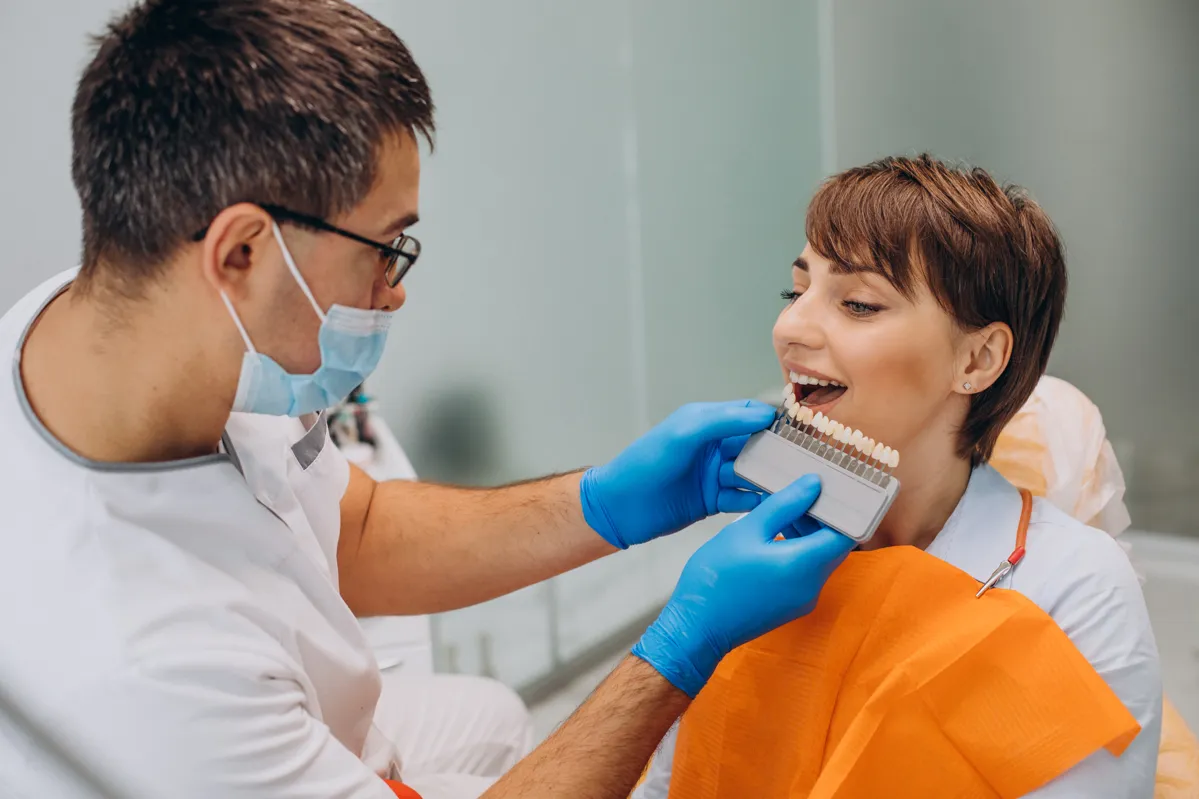
Teeth whitening is a procedure that lightens the shade of the teeth by several steps, using agents applied under a dentist's supervision to break down colour pigments inside the natural tooth. How noticeable the result is, and how long it lasts, depends on the cause of the discolouration, the structure of the tooth and your own habits. On this page you will find the types of staining, the in-clinic and home methods, how sensitivity is managed and who whitening is not suitable for.
What teeth whitening is, and what it is not
Whitening is more than wiping stains off the surface of the teeth. The agents used usually contain hydrogen peroxide, or carbamide peroxide, which breaks down into hydrogen peroxide in the mouth. These substances pass through the porous structure of the enamel and break down the coloured molecules inside the enamel and the dentine beneath it, so the tooth looks lighter. A scale and polish, by contrast, only removes deposits and stains from the surface; it does not change the tooth's own colour. For this reason a professional clean is often carried out before whitening, and sometimes the clean alone produces the brightness the patient was hoping for.
Older sources sometimes claim that whitening "makes teeth healthier". This is not correct. Whitening is a cosmetic procedure. It does not increase the tooth's resistance to decay or gum disease. When carried out correctly in a healthy mouth it is considered not to harm the teeth, but it cannot be said to improve their health.
Why do teeth change colour?
Discolouration is divided into two groups according to where it comes from: extrinsic (external) and intrinsic (internal). Which one is dominant largely determines how well the teeth respond to whitening.
Extrinsic staining
- Drinks: Tea, coffee, red wine, cola and dark fruit juices leave colour on the surface and in the outer layers of the enamel.
- Tobacco: Cigarettes and hookah (shisha) cause stubborn yellow-brown stains.
- Certain foods and spices: Turmeric, soy sauce, beetroot and dark sauces.
- Some mouthwashes: Long-term use of mouthwashes containing chlorhexidine can cause brown staining.
- Inadequate oral hygiene: Plaque and tartar hold on to coloured substances.
Extrinsic staining usually responds well to cleaning and whitening.
Intrinsic staining
- Ageing: Enamel thins over time, so the naturally more yellow dentine underneath shows through more. Dentine also darkens with age.
- Genetics: Some people naturally have teeth with a more yellow or grey tone.
- Certain medicines taken while the teeth were developing: Tetracycline-group antibiotics taken in childhood can cause grey-brown discolouration, sometimes in bands.
- Excess fluoride (fluorosis): This can produce white or brown patches.
- Trauma and loss of nerve vitality: If the nerve of a tooth that has taken a knock dies, the tooth gradually darkens.
- Root-filled teeth: A common reason why a single tooth looks darker than the others.
Intrinsic staining responds to whitening more slowly and to a more limited extent. With tetracycline staining the result is often partial, and restorative options such as veneers may be discussed for some people. For a single darkened tooth, the state of its root canal treatment is assessed and, where appropriate, internal whitening (bleaching the tooth from the inside) may be considered. Details about root canal treatment are on the root canal treatment page.
In-clinic and home whitening
In-clinic whitening
This is carried out at the polyclinic by the dentist. The gums and lips are covered with a protective barrier and a higher-concentration whitening gel is applied to the teeth. The gel is refreshed at set intervals; the length of the session depends on the system used but is usually around an hour. Some systems use a light, although opinions in the dental literature differ on how much the light contributes to the result. More than one session may be planned if needed.
The advantages are that the change is seen quickly and that contact between the gel and the gums is controlled by the dentist. On the other hand, because of the higher concentration, sensitivity after the session can be more noticeable.
Home whitening
Thin, clear custom trays are made from an impression of your teeth. You place the lower-concentration gel supplied by the dentist into the trays and wear them for the recommended time, often overnight or for a few hours during the day. The course usually lasts two to four weeks, and can take longer depending on the type of staining.
Home whitening works more slowly but allows the colour to lighten in a controlled way, and sensitivity is milder for most people. If you keep the trays, they can also be used for short refresher courses later. Its success depends on wearing the trays consistently.
Combined approach
In some cases it is preferable to start with one in-clinic session and continue with home whitening. This combines a quick start with controlled progress.
| Feature | In-clinic | Home |
|---|---|---|
| Carried out by | The dentist, at the polyclinic | You, at home, under the dentist's supervision |
| Gel concentration | Higher | Lower |
| When the change is seen | By the end of the session | Gradually over a few weeks |
| Sensitivity | Can be more noticeable | Usually milder |
| Your involvement | Minimal | Regular tray wear is essential |
| Suitable when | A quicker change is wanted, or trays are difficult to wear | Stubborn staining, sensitive teeth, gradual progress preferred |
A note on over-the-counter products
Whitening toothpastes mostly reduce surface stains with abrasive particles; they do not significantly change the inner colour of the tooth. Long-term use of harsh abrasives can wear down enamel and exposed root surfaces. Ready-made strips and one-size trays do not fit the teeth closely, so gel can spill onto the gums and results can be patchy. An examination before whitening makes sure that problems such as decay, cracks and gum recession are picked up.
The process step by step
- Examination: Decay, open filling margins, cracks, gum recession and existing restorations are assessed.
- Recording the shade: The starting colour is recorded with a shade guide and photographs, so the change can be tracked objectively.
- Cleaning: Tartar and surface stains are removed.
- Choosing the method: In-clinic, home or combined whitening is decided.
- Treatment: The in-clinic session is carried out, or the home trays are handed over with instructions for use.
- Review: Colour and sensitivity are checked and the duration adjusted if needed.
- Matching restorations: If old fillings on the front teeth now look a different colour, their replacement can be planned once the new shade has settled (usually after about two weeks).
Sensitivity and how it is managed
Sensitivity to cold, and sometimes to heat, during and after whitening is a common side effect. For most people it is mild and temporary, easing within a few days of finishing treatment. Some people feel brief, sharp twinges. Sensitivity is not usually a sign of permanent damage; it is linked to the agent temporarily affecting the nerve endings in the dentine.
The following can help reduce sensitivity:
- Using a desensitising toothpaste (containing potassium nitrate or fluoride) for a week or two before whitening and throughout the process
- Shortening the time the home trays are worn, or leaving a day between applications
- Applying a fluoride or desensitising gel in the trays as recommended by the dentist
- Avoiding very cold and very hot drinks during the process
- Adjusting the gel time or number of sessions for in-clinic whitening
White patches or a burning feeling on the gums may mean the gel has touched the gum; this usually settles quickly. If pain lasts or keeps getting worse, stop the treatment and contact your dentist.
Who is whitening not suitable for?
- Pregnant or breastfeeding women: There is not enough safety data for this period, so whitening is postponed.
- Children and young teenagers: Their tooth nerve chambers are large, so the risk of sensitivity is higher; whitening is usually postponed.
- People with untreated decay or open filling margins: The agent can reach the inside of the tooth and cause severe sensitivity. Fillings are done first.
- People with active gum disease: Gum treatment is needed first.
- People with marked gum recession and exposed root surfaces: Root surfaces do not whiten and sensitivity may increase.
- People who are allergic to peroxide.
- People with large fillings, crowns or veneers on their front teeth: Fillings, crowns and veneers do not whiten. When the natural teeth lighten, these restorations stay darker and the difference can become more obvious. In this case, replacing the restorations after whitening should be included in the plan.
In people with white spots (for example from fluorosis, or enamel marks left after braces), whitening can lighten the background and make the spots look more noticeable for a while. Other approaches are considered in these cases.
How long does the result last?
The effect of whitening is not permanent; teeth gradually pick up colour again. How long the effect lasts varies widely between individuals, with reported ranges from a few months to a few years. The main factors are:
- Tobacco use: One of the factors that brings colour back most quickly.
- Coloured food and drink: How often you drink tea and coffee makes a real difference.
- Oral hygiene: Regular brushing, cleaning between the teeth and periodic professional cleaning help maintain the colour.
- Type of staining: Colour tends to return more noticeably with intrinsic staining.
- Refresher treatments: If you keep your home trays, short refresher courses can be done at intervals recommended by your dentist.
Repeating whitening too often is not recommended. How often and for how long to repeat it should be decided together with your dentist.
Eating and drinking after whitening
In the days immediately after whitening, enamel is more permeable to coloured substances. During this period, a "white diet" is often recommended, usually for the first 48 hours:
- Good choices: Water, milk, plain yoghurt, white cheese, chicken, fish, rice, pasta with a light sauce, potatoes, bananas, white bread and light-coloured vegetables.
- Worth avoiding: Tea, coffee, red wine, cola and dark drinks such as sour cherry or pomegranate juice; tomato sauce, soy sauce, curry and turmeric; chocolate; dark-coloured fruit; smoking.
- Acidic food and drink: Lemon, vinegar and fizzy drinks can both encourage staining and increase sensitivity, so it is advisable to cut down on them during this time.
After this period, drinking dark drinks through a straw and rinsing with water afterwards can help slow down staining. After an acidic drink, waiting about half an hour before brushing is kinder to the enamel than brushing straight away.
Common mistakes
- Starting whitening without an examination and missing decay or a crack
- Wearing home trays for longer than recommended, or using too much gel
- Forgetting that old fillings on the front teeth will not whiten
- Carrying on without a break once sensitivity starts
- Repeating whitening too often
Teeth whitening in Ankara
Yetkindent is an oral and dental health polyclinic in YDA Center, Çankaya, Ankara, on Dumlupınar Boulevard (Eskişehir Road) near Çukurambar and Söğütözü. Before whitening, the teeth, gums and any existing restorations are assessed. If colour and shape are to be addressed together, whitening can be considered as the first step of a smile design plan. Where a front-tooth crown would remain darker, options such as zirconia crowns are discussed as part of the same plan. The treatment plan is made after an in-person examination; you can contact the polyclinic on +90 501 101 17 17 or at yetkindent@gmail.com. Opening hours are Monday to Saturday, 09:00 to 19:00, and the polyclinic is closed on Sundays.
Frequently Asked Questions
Does teeth whitening damage enamel?
Whitening carried out under a dentist's supervision, at suitable concentrations and for suitable lengths of time, is considered not to cause permanent damage to healthy enamel. Uncontrolled and frequently repeated use, especially combined with abrasive products and acidic drinks, can cause problems with enamel and sensitivity.
Will my fillings and crowns whiten too?
No. Composite fillings, porcelain and zirconia crowns and veneers are not affected by whitening agents. Once the natural teeth have lightened, there may be a colour difference between them and these restorations; if so, replacing them can be planned.
How long does whitening take?
In-clinic whitening usually consists of one or more sessions of around an hour each. Home whitening usually takes two to four weeks and may take longer depending on the type of staining.
How long does the sensitivity last?
For most people it is mild and temporary, easing within a few days of finishing treatment. Desensitising toothpastes and gels can help. If pain persists, see your dentist.
How white can my teeth go?
The shade that can be reached depends on the starting colour of the tooth, its structure and the cause of the discolouration. Every tooth has a limit; continuing beyond that point does not noticeably change the colour and can increase sensitivity.
Can I whiten my teeth while wearing braces?
Because brackets cover part of the tooth surface, whitening during treatment does not give an even result. It is usually planned after orthodontic treatment has been completed.
Can I have my teeth whitened during pregnancy?
Whitening is not recommended during pregnancy or breastfeeding; it is postponed until after this period.
This content is for information only and does not replace an examination or diagnosis. The treatment that suits you is decided together with your dentist after a clinical examination and any necessary tests.