
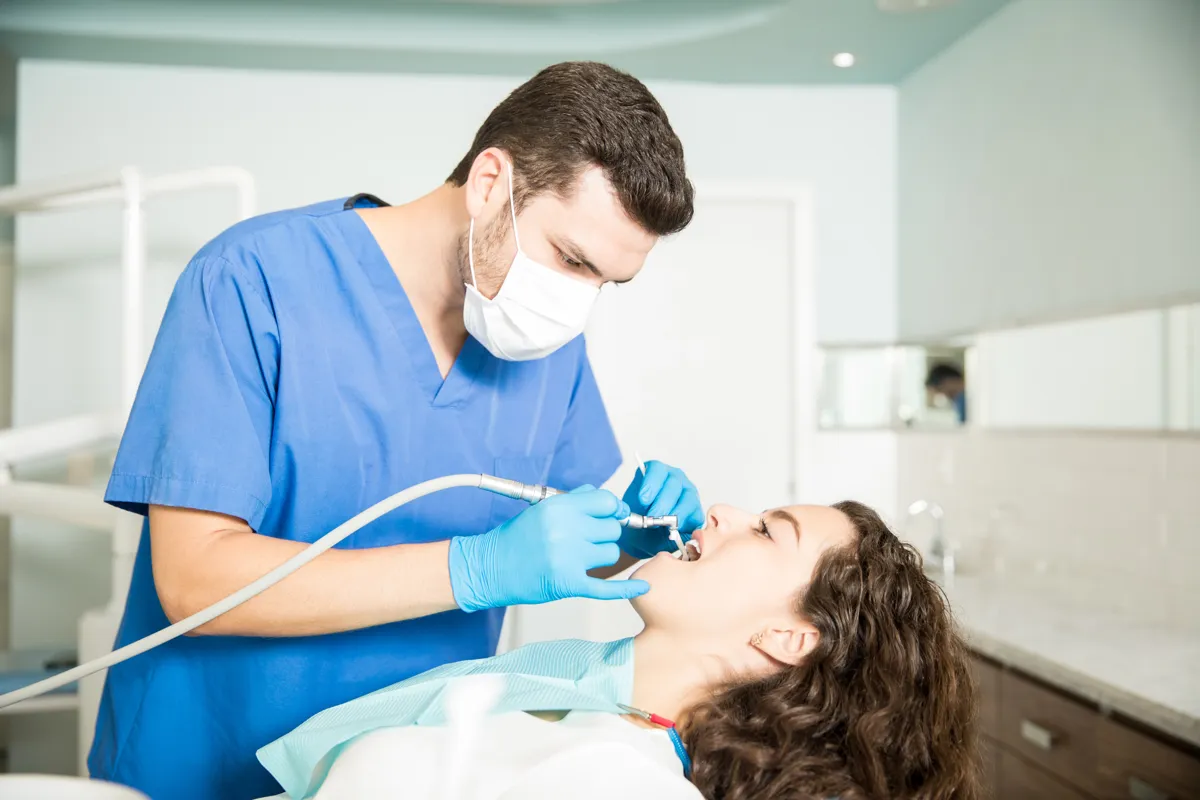
Root canal treatment is an endodontic procedure that aims to keep a tooth in the mouth when the nerve and blood vessel tissue inside it (the pulp) becomes inflamed or infected, by removing this tissue and filling the root canals. The goal is to save the tooth rather than extract it, and to remove the source of the pain and infection. This page explains which symptoms raise the need for root canal treatment, how the procedure is carried out step by step, what to expect afterwards and how it compares with extraction.
What is inside a tooth: the pulp and root canals
A tooth is made up of enamel on the outside, dentine beneath it and, at its centre, a soft tissue called the pulp. The pulp contains nerves, blood vessels and connective tissue, and it continues along narrow canals running from the crown of the tooth to the tips of the roots. Front teeth usually have a single canal, while back teeth have two, three or more; the number and shape of the canals can vary from person to person.
When bacteria reach the pulp through deep decay, a fracture, a crack or repeated dental work, the pulp becomes inflamed (pulpitis). While the inflammation is still reversible, removing the decay and placing a suitable filling may be enough. Once it becomes irreversible, or the pulp dies (necrosis), the infection can spread to the bone around the root tip and an abscess can form. At this point, root canal treatment is usually the way to save the tooth.
Root canal treatment does not "bring the pulp back to life". It removes the inflamed or dead pulp tissue, cleans and shapes the canals, and fills them so that bacteria cannot get back in. Even without its pulp, the tooth can continue to function in the mouth thanks to the bone and connective tissue around it.
Symptoms that may point to the need for root canal treatment
The following symptoms may suggest that root canal treatment is needed, but the diagnosis is made through examination, tests and X-rays. Some teeth show no symptoms at all, and inflammation at the root tip is only seen on a routine X-ray.
- Throbbing pain that lingers long after a hot or cold stimulus has been removed
- Pain that starts on its own, especially pain that wakes you at night
- Increased sensitivity when biting or touching the tooth
- Swelling of the gum, a pimple-like bump on the gum (a sinus tract, or fistula) or a bad taste in the mouth
- Swelling of the face or jaw
- The tooth turning grey or darker
- Deep decay, a fracture or a crack
Pain that fades by itself over time is not always a good sign. Once the pulp has died completely the pain may ease, but the infection can continue to spread quietly at the root tip.
When is root canal treatment needed?
- Irreversible pulpitis: the stage at which inflammation of the pulp will no longer heal.
- Pulp necrosis: the nerve has died; this often comes with discolouration or inflammation at the root tip.
- Abscess: a collection of pus at the root tip or in the gum.
- Trauma: teeth that break after a knock and expose the pulp, or that gradually lose vitality over time.
- Prosthetic reasons: in some cases, when a crown or bridge is being planned, the tooth may need to be prepared with root canal treatment first.
For root canal treatment to be possible, the tooth has to be restorable. In situations such as a vertical fracture running along the root, advanced loss of supporting bone, or too little tooth structure left to restore, root canal treatment may not be suitable. In these cases, extraction and options for replacing the missing tooth are considered.
How is root canal treatment carried out, step by step?
1. Examination and diagnosis
The history of the pain is taken, and tests such as a cold test, percussion (light tapping) and palpation are carried out on the tooth. A periapical X-ray shows the roots, the canals and the bone at the root tip. In complex cases, three-dimensional imaging may be needed. Once the diagnosis is clear, the treatment plan and how the tooth will be restored afterwards are discussed.
2. Local anaesthetic
The tooth and the area around it are numbed. In teeth with severe inflammation, the anaesthetic may take longer to work; in that case, additional anaesthetic can be given. If you feel discomfort at any point during the procedure, simply tell your dentist.
3. Isolation
The tooth is isolated from the rest of the mouth with a rubber sheet (rubber dam). This prevents the canals from being recontaminated by bacteria in the saliva and stops the irrigation solutions from getting into the mouth.
4. Opening the access cavity
Decayed tissue is removed and the pulp chamber is reached through the crown of the tooth. The entrances to the canals are located.
5. Measuring canal length, cleaning and shaping
The length of each canal is measured with an electronic apex locator and X-rays. The canals are then widened and shaped using fine hand or rotary files. During this stage they are flushed generously with disinfecting solutions. The aim of cleaning is to remove as much infected tissue and as many bacteria from the canal walls as possible.
6. Medication inside the canal, if needed
Where infection is severe or discharge does not stop, an antibacterial medicament is placed in the canals for a period and the tooth is sealed with a temporary filling. In this case, treatment is completed at the next appointment.
7. Filling the canals
Once dried, the canals are sealed all the way to the root tip with a rubber-like material called gutta-percha and a root canal sealer. A check X-ray is used to assess the length and density of the filling.
8. Restoring the tooth
Root canal treatment is not complete until the upper part of the tooth has been sealed with a sound restoration. A temporary filling is not permanent; a permanent filling or crown should be placed soon afterwards. This decision is explained separately below.
One visit or several?
Depending on the condition of the tooth, root canal treatment can be completed in a single visit or over two to three visits. Research shows no clear difference in healing rates between single-visit and multiple-visit treatment in suitable cases. The decision is made according to the clinical situation.
| Situation | A single visit may be more suitable | Several visits may be more suitable |
|---|---|---|
| Condition of the pulp | Living but inflamed pulp (pulpitis) | Dead pulp, widespread inflammation at the root tip |
| Discharge and swelling | Canals dry, no swelling | Ongoing discharge from the canal, swelling present |
| Canal anatomy | Canals accessible and of standard shape | Curved, narrow, calcified or numerous canals |
| Patient comfort | Patient can keep the mouth open for a long time | A long session is difficult for the patient |
| Retreatment | Rarely | Often, when old filling material has to be removed |
A single session usually takes between 45 minutes and an hour and a half; it can take longer for back teeth and complex canals.
Pain and recovery after root canal treatment
For a few days after treatment, it is common to have tenderness when biting, a mild ache or a feeling of tightness in the surrounding tissues. This is the normal response of the tissues at the root tip to the procedure and usually eases within a few days. In teeth that had severe pain or an abscess before treatment, this tenderness may last a little longer.
Managing the discomfort
- Do not eat until the anaesthetic has worn off (usually 2 to 3 hours); you could bite your lip or cheek.
- Take any painkiller your dentist recommends at the dose and interval advised. Antibiotics are not needed for every root canal treatment; they are prescribed by the dentist only in situations such as spreading infection, fever or marked swelling.
- Until the permanent restoration is in place, avoid biting hard foods with the treated tooth. A root-treated tooth that has not yet been covered is more prone to fracture.
- Carry on brushing and flossing as normal.
When should you contact your dentist?
- If the pain is getting worse instead of easing over a few days
- If there is new or growing swelling in the face or gum
- If general symptoms such as fever or difficulty swallowing appear
- If the temporary filling has come out or the tooth has broken
- If the tooth feels "high" when you bite
Filling or crown after root canal treatment?
The long-term success of root canal treatment depends as much on how the upper part of the tooth is restored as on how the canals are filled. A leaking or incomplete restoration can allow the canals to become contaminated again.
| Situation | Usually preferred |
|---|---|
| Front tooth with little loss of structure | A composite filling is often sufficient |
| Molar or premolar with walls largely intact | A filling, or an onlay/inlay covering the cusps of the tooth |
| Molar or premolar with one or more walls missing | A cusp-covering restoration or a crown |
| Very little tooth structure left | A post inside the canal covered by a crown; if there is not enough tooth left, extraction is discussed |
Because back teeth carry the chewing load, a cusp-covering restoration on a root-treated molar generally reduces the risk of fracture. Where a crown is needed, see the zirconia crowns page for material options, and the fillings page for cases where a filling is sufficient. The permanent restoration is recommended soon after root canal treatment.
Success rates and risks of root canal treatment
Most root canal treatments that are carried out properly and well restored function without problems for many years. As with any treatment, however, there are some risks:
- The canal system cannot be cleaned completely (for example, an extra canal that was not detected, or very curved or calcified canals)
- An instrument breaking inside the canal; in most cases it can be removed or bypassed, but sometimes it affects the treatment plan
- Perforation of the root wall; this is rare and can be repaired with suitable materials
- Reinfection caused by a delayed or leaking restoration
- Fractures or cracks developing in the treated tooth over time
Root-treated teeth are not immune to decay. Regular brushing, flossing and periodic check-up X-rays allow any problems to be picked up early.
Root canal retreatment
If a tooth that has already had root canal treatment develops pain, swelling, a sinus tract or growing inflammation at the root tip on an X-ray, retreatment may be considered. Possible causes include canals that were not cleaned in the earlier treatment, an inadequate filling, a leaking restoration or new decay.
In retreatment, the existing crown or filling is removed if necessary, the old root filling is taken out, and the canals are cleaned, shaped and filled again. The procedure is more complex than the first treatment and usually requires more than one visit. In suitable cases it is an effective option that allows the tooth to stay in the mouth.
Apicoectomy: a brief overview
An apicoectomy (root-end resection) is a minor surgical procedure used when inflammation at the root tip has not healed despite root canal treatment and retreatment through the canal is not possible or not sufficient. Under local anaesthetic, the gum is lifted, the root tip is reached, the inflamed tissue is removed, a few millimetres of the root tip are cut away and the end of the canal is sealed with a suitable material. The gum is then stitched back into place.
This procedure is generally considered for teeth with a post or crown that cannot be removed, a broken instrument at the root tip, or anatomical features that cannot be reached through the canal. The decision is made after an oral surgery and endodontic assessment, based on the X-ray findings and the overall condition of the tooth.
Root canal treatment or extraction?
With a painful tooth, extraction can look like the quicker route in the short term. But the gap left by an extracted tooth brings new decisions with it.
| Criterion | Root canal treatment and restoration | Extraction |
|---|---|---|
| Keeping the natural tooth | Your own tooth root and the surrounding tissues are preserved | The tooth is lost |
| Chewing and bite | The bite is preserved | If the gap is not filled, neighbouring and opposing teeth may shift |
| Bone | The surrounding bone is preserved | Bone at the extraction site may shrink over time |
| Next step | Filling or crown | Assessment for an implant, bridge or removable denture |
| Time and visits | Usually 1 to 3 visits plus the restoration | Extraction in one visit; replacing the tooth can take months |
| When it is not suitable | Vertical root fracture, advanced bone loss, too little tooth left to restore | Generally not the first choice when the tooth can be saved |
If the tooth cannot be saved, the dental implant treatment page and the article on options for missing teeth explain how a missing tooth can be replaced. The general principle is this: a natural tooth that can be kept healthy is, in most cases, the first thing to try to save.
Common mistakes
- Going around with a temporary filling for a long time because the pain has gone; temporary fillings leak and the tooth can break
- Putting a root-treated molar under strain with hard foods before it has been crowned
- Taking antibiotics without a prescription and putting off treatment; antibiotics do not remove the source of the infection
- Skipping check-ups on a tooth whose pain has eased; inflammation at the root tip can progress without symptoms
Root canal treatment assessment in Ankara
Yetkindent Oral and Dental Health Polyclinic provides care in several areas of dentistry, including endodontics, at YDA Center on Dumlupınar Boulevard (Eskişehir Road) in Çankaya, Ankara, near Çukurambar and Söğütözü. Root canal treatment is planned on the basis of an in-person examination, tests and X-ray assessment, and how the tooth will be restored afterwards is discussed from the start. Because some cases need more than one visit plus a separate appointment for the permanent restoration, it helps to plan to be available in Ankara until the tooth has been fully restored. For an examination and assessment, you can contact the polyclinic.
Frequently Asked Questions
Will I feel pain during root canal treatment?
The procedure is carried out under local anaesthetic, and most patients do not feel significant pain during treatment; pressure or vibration may be felt. In teeth with severe inflammation, numbness can be harder to achieve, in which case additional anaesthetic is given.
When can I eat after root canal treatment?
You can eat once the numbness has worn off, usually within 2 to 3 hours. Until the permanent restoration is placed, it is advisable not to bite hard foods with the treated tooth.
How long does a root-treated tooth last?
Root canal treatments that are carried out well and sealed with a leak-free restoration function for many years in most cases. How long the tooth lasts depends on how much tooth structure remains, the quality of the restoration, oral hygiene and habits such as teeth grinding.
Why does a tooth change colour after root canal treatment?
Blood products from the pulp or certain root canal materials can gradually darken the tooth. In front teeth this can be addressed with internal bleaching, a filling or a crown. The teeth whitening page explains how whitening methods work.
Can root canal treatment be done during pregnancy?
It can be done when necessary; the second trimester is generally considered the most suitable period. X-rays and medication are planned carefully. You should tell your dentist that you are pregnant before treatment.
Is root canal treatment or an implant the better choice?
They treat different situations. For a tooth that can be saved, root canal treatment with a suitable restoration is considered first. If the tooth cannot be saved, an implant is one of the options for replacing it. The decision depends on the condition of the tooth and the surrounding tissues.
If I take antibiotics, do I still need root canal treatment?
Yes. Antibiotics can temporarily suppress a spreading infection, but they do not act on the infected tissue inside the canal. Unless the source of the infection is removed by root canal treatment or extraction, the symptoms usually come back.
This content is for information only and does not replace an examination or diagnosis. The treatment that suits you is decided together with your dentist after a clinical examination and any necessary tests.