
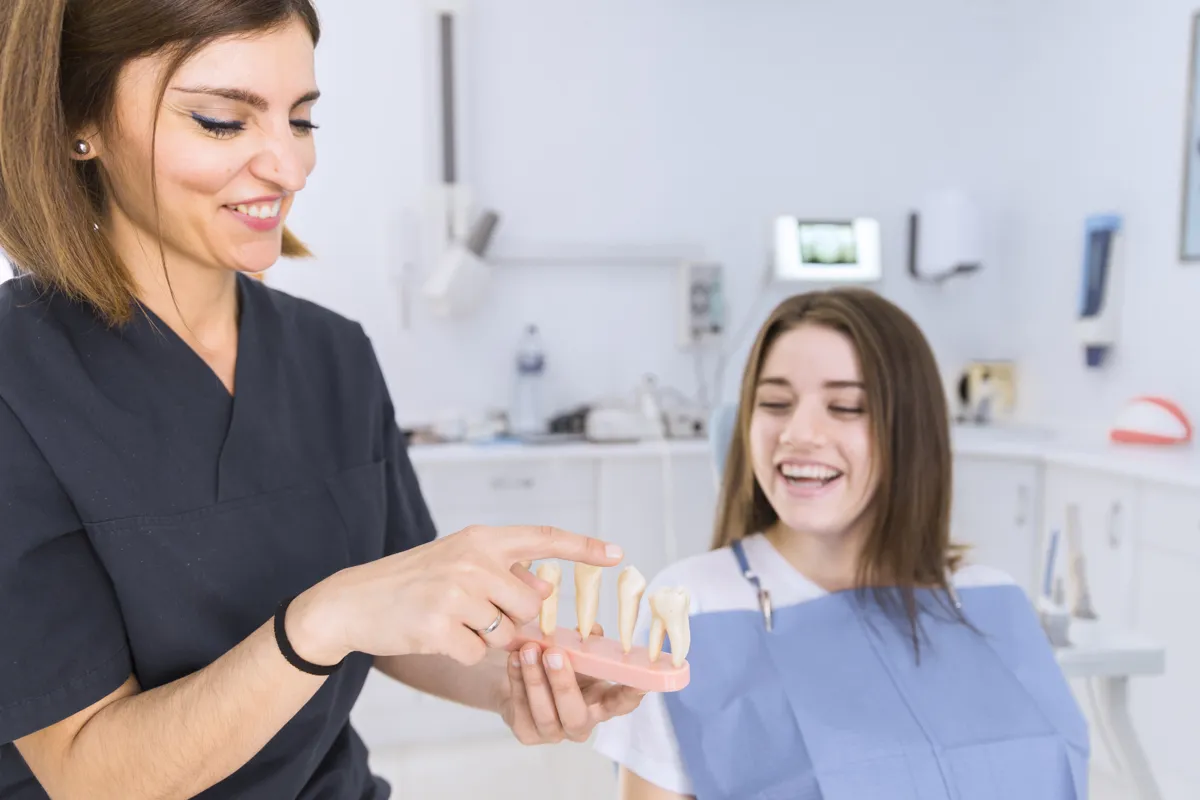
Orthodontic treatment is the branch of dentistry that diagnoses, prevents and corrects teeth and jaws that sit in the wrong position relative to each other. The aim is not only a straight row of teeth, but a bite that closes correctly, chewing forces that are shared evenly and teeth that can be kept clean for decades. On this page you will find which problems fall within orthodontics, what the treatment options are, and why protecting the result after treatment matters as much as the treatment itself.
What does orthodontics deal with?
Orthodontics asks two separate questions: are the teeth in the right order within their own jaw, and do the upper and lower jaws meet each other correctly? The first question covers problems of the dental arch itself, such as crowding, gaps and rotated teeth. The second concerns the bite, or malocclusion: how the teeth touch when the mouth closes. A patient may have front teeth that look straight while the back teeth do not meet at all. The opposite is also possible: the bite is correct and there is only mild crowding at the front.
This distinction matters because it defines the scope of treatment. An irregularity limited to the dental arch can often be corrected with braces or clear aligners. A problem that comes from the position of the jaws relative to each other can, in a growing child, be guided with orthopaedic appliances. In an adult whose growth is complete, the same problem is sometimes camouflaged by moving the teeth, and sometimes needs a plan that combines orthodontics with jaw surgery.
The main problems that call for orthodontic treatment
Crowding
Crowding means the teeth do not fit in the jawbone, so they overlap or turn on their own axis. It is the most common orthodontic problem. Beyond appearance, overlapping teeth are harder to clean with a brush and floss, which encourages plaque build-up, gum inflammation and decay. Mild crowding can often be resolved by removing very small amounts of enamel between the teeth or by widening the arch. When space is severely limited, extraction of some teeth is sometimes planned. Which route is chosen depends on the facial profile, lip support and bone structure.
Gaps between teeth (diastema)
This is the opposite of crowding: the teeth are small for the jaw, or a tooth is missing. A gap between the two upper front teeth is the most noticeable cosmetic concern. The cause may be tongue pressure, a thick lip attachment (frenum) or a missing tooth. A gap that is closed without identifying its cause tends to open again.
Open bite
In an open bite the back teeth meet but the front teeth do not, leaving a vertical opening between them. The patient may find it hard to bite through a thread or a piece of pasta with the front teeth. Long-standing thumb sucking in childhood, dummy use, pushing the tongue forward when swallowing and mouth breathing are frequently seen together with open bite. For this reason treatment is not limited to moving teeth; if the habit is not addressed as well, the result may not last.
Deep bite
In a deep bite the upper front teeth cover the lower front teeth too much in the vertical direction. In advanced cases the lower incisors touch the palate and the upper incisors touch the lower gum, and the tissue in these areas can be damaged. A deep bite can be accompanied by wear on the front teeth and, in some patients, by jaw joint complaints.
Crossbite
Normally the upper teeth close outside the lower teeth. In a crossbite one or more upper teeth sit on the inner side of the lower teeth. It may involve a single front tooth, or the back teeth on one or both sides. A one-sided crossbite at the back can cause the lower jaw to shift to one side in children. If it is noticed while the child is still growing, it can often be corrected relatively simply with appliances that widen the upper jaw.
Class II and Class III bite problems
Orthodontists describe the front-to-back relationship of the jaws in classes. Class I means the molars meet in the correct relationship; if there is a problem, it is usually within the dental arch. In Class II the lower jaw sits behind the upper jaw: the upper front teeth look prominent, the profile is convex and a "receding chin" appearance may develop. In Class III the lower jaw is forward, or the upper jaw is behind; the lower front teeth close in front of the upper front teeth.
In these two groups, timing is decisive. In a growing child, functional and orthopaedic appliances that guide jaw development can be effective. Once growth has finished, the same problem is often compensated by changing only the position of the teeth. In adults with a pronounced skeletal difference, orthognathic treatment, in which orthodontics and jaw surgery are planned together, may be considered.
Midline shift and impacted teeth
When the centre lines of the upper and lower front teeth do not match, the cause may be neighbouring teeth drifting after the early loss of a baby tooth. Teeth that remain impacted in the bone, especially upper canines, can be surgically exposed and brought into position with orthodontic force if they are noticed in time. These cases require joint planning between oral surgery and orthodontics.
Why have treatment?
Some orthodontic problems concern appearance alone, and treating them is a personal choice. Others set the stage for further problems over time:
- Plaque builds up in areas that are hard to clean, raising the risk of decay and gum disease.
- An unbalanced bite can place excess load on some teeth, which can cause wear and fractures.
- In a deep bite, the palate and gum tissue can be traumatised.
- An open bite and some jaw discrepancies can make biting, chewing and the pronunciation of certain sounds harder.
- Correctly positioned teeth provide a healthier foundation for any future implant, crown or bridge work.
Treatment options
The method is chosen according to the type of problem, the patient's age, their expectations for daily life and how consistently they can follow instructions. There may be more than one way to solve the same problem; at the examination these options are discussed together with their advantages and drawbacks.
Fixed braces
Brackets are bonded to the teeth and wires placed in them apply controlled force to the teeth. Metal, ceramic or clear brackets, self-ligating systems and lingual brackets bonded to the inner surfaces of the teeth are the options within this group. Fixed treatment has a wide range of use in complex tooth movements, rotated teeth and cases where root position needs precise control. We compare bracket types and describe daily life with braces in detail on our dental braces page.
Clear aligner treatment
A series of custom-made clear aligners, changed in sequence, moves the teeth step by step. The aligners can be taken out for eating and brushing. That flexibility also brings responsibility: if the aligners are not worn for most of the day, the planned movement does not happen. You can read which cases are suitable and how the process works in our article on clear aligner treatments.
Children's orthodontics and orthopaedic appliances
The growth period is when orthodontics has the most to work with. While the jaws are still developing, appliances can be used to widen the upper jaw, support the forward growth of the lower jaw or break harmful habits. These early interventions can reduce the need for more extensive treatment later. The recommended age for a first orthodontic examination is generally 7. More details are on our children's orthodontics page.
Removable appliances and auxiliary mechanics
Some small tooth movements or treatment stages are carried out with appliances the patient can put in and take out. In complex cases, auxiliary mechanics such as elastics and temporary anchorage screws may be added to the plan. Which of these will be needed is anticipated at the start, but the plan can be updated during treatment according to how the teeth respond.
| Method | Visibility | Dependence on patient cooperation | Where it tends to be used |
|---|---|---|---|
| Fixed braces | Depends on bracket type | Low to moderate (hygiene and attending appointments) | Complex tooth movements, marked crowding, impacted teeth |
| Clear aligners | Low | High (daily wear time is decisive) | Adults and teenagers with consistent wearing habits, in suitable cases |
| Orthopaedic / functional appliance | Depends on appliance type | High for removable types | Jaw discrepancies in growing children |
The treatment process step by step
- Examination and consultation: Your concerns are heard, and your mouth and facial structure are examined. Whether treatment is needed, and if so when it would be sensible to start, is discussed.
- Records: Panoramic and cephalometric X-rays, intraoral and facial photographs, and impressions or a digital scan of the teeth are taken. These records are the basis of the diagnosis.
- Diagnosis and treatment plan: The records are analysed; the problem, the goals, the proposed method, possible alternatives, the estimated duration and the risks are shared with you.
- Preparation: Any decay, gum inflammation or tartar is dealt with before treatment begins. Teeth are not moved in an unhealthy mouth.
- Active treatment: Brackets are bonded or the aligner series begins. The teeth are moved gradually.
- Regular check-ups: With fixed braces these are usually every 4 to 8 weeks; with aligners, at intervals set by the orthodontist.
- Removal of appliances: Once the target position is reached, the brackets are removed and the teeth are cleaned.
- Retention: A retainer is fitted, and check-ups continue at longer intervals.
Orthodontic treatment cannot be planned from photographs or messages alone; an in-person examination and records are needed first. Because active treatment involves regular appointments over many months, patients who live abroad or visit Ankara only occasionally should consider whether they can attend follow-up visits here before starting.
How long does treatment take?
Duration varies considerably from person to person. Mild crowding may be corrected in a few months to a year, while comprehensive treatment that also corrects the bite usually takes 18 to 30 months. The main factors are the severity of the problem, whether extractions are needed, bone structure, age and how well the patient keeps to appointments and instructions. Broken brackets, missed appointments and aligners that are not worn enough all lengthen treatment. The duration given at the start is an estimate; progress is assessed at check-ups and the estimate is updated.
Orthodontics for adults
There is no age limit for orthodontic treatment; in adults with healthy gums and bone, teeth can be moved at any age. Because jaw growth is complete in adults, skeletal differences cannot be guided through growth, and the plan is made with that in mind. Where there is gum recession, bone loss, old fillings and crowns, or missing teeth, orthodontic treatment can be planned together with gum, implant or prosthetic treatment. For example, if a gap from a missing tooth has partly closed and the neighbouring teeth have tilted, bringing the teeth back into the correct position first can create more suitable space for dental implant treatment.
The retention (retainer) phase
When the teeth reach their new position, the visible part of treatment ends, but the work does not. During tooth movement, the fibres that attach the teeth to the bone and the surrounding tissues are remodelled, and it takes months for these tissues to adapt to the new position. During this time the teeth tend to move back towards where they were. Teeth also continue to shift slightly throughout life. The retention phase is therefore an inseparable part of orthodontic treatment.
Fixed retainer
A fixed retainer is a thin wire bonded to the inner surfaces of the front teeth. It is not visible from outside and does not depend on the patient remembering to wear it. Tartar tends to collect around the wire, so it needs to be cleaned with floss threaders and checked regularly. If the wire breaks or comes loose at one point, it should be repaired promptly; otherwise the tooth concerned can move.
Removable retainer
Removable retainers are made either as a clear aligner-style tray or from wire and acrylic, and can be taken in and out. They are usually worn for most of the day at first, then only at night. The orthodontist decides the wearing time. They should not be placed in hot water or wrapped in a napkin and left on a table; keep them in their case.
Partial relapse of the teeth towards their old position is common in patients who stop wearing retainers. For this reason long-term, and in many cases indefinite, night-time retention is usually recommended.
Possible side effects and risks
- Tenderness and pressure: For a few days after brackets are fitted or a wire is changed, the teeth feel under pressure. In most patients this eases quickly.
- Enamel marks and decay: Plaque left around brackets can cause white spots on the enamel and decay. Hygiene is decisive for the outcome.
- Gum inflammation: With inadequate brushing the gums may swell and bleed.
- Root shortening: Some patients show slight shortening of the tooth roots. It is usually of little clinical significance and is monitored with X-rays.
- Relapse: If the retainer is not worn, the teeth can move.
- Soft tissue irritation: In the first weeks brackets can irritate the inside of the cheeks and lips; orthodontic wax makes this period easier.
Common mistakes
- Postponing a child's first orthodontic examination until all the baby teeth have fallen out.
- Judging treatment only by how the front teeth look and ignoring the bite.
- Leaving a broken bracket or a loose wire until the next appointment.
- Wearing clear aligners only "now and then".
- Stopping retainer wear once treatment is finished.
- Neglecting general dental and gum check-ups during treatment with braces.
Orthodontics at Yetkindent
At our polyclinic, orthodontic treatment is planned by Specialist Orthodontist Dr. Zeynep Yetkin, who graduated from Hacettepe University Faculty of Dentistry in 2013 and completed her orthodontic specialty training at Selçuk University in 2018. Fillings, gum treatment or root canal treatment that may be needed before orthodontics can be carried out under the same roof. The polyclinic is at YDA Center on Dumlupınar Boulevard (Eskişehir Road) in Çankaya, Ankara, close to Çukurambar and Söğütözü. To learn more about the clinic and the orthodontist, see our about us page.
We have covered common misconceptions in a separate article: orthodontic myths and facts.
You can contact the polyclinic to arrange an examination and assessment.
Frequently Asked Questions
At what age does orthodontic treatment start?
A first orthodontic examination is generally recommended at around age 7. When treatment actually starts depends on the problem: some jaw problems are treated early, while many problems of tooth alignment are treated after the permanent teeth have come through. There is no upper age limit for adults.
Does orthodontic treatment hurt?
Most people describe the treatment as pressure and tightness rather than pain. The teeth may be tender for a few days after brackets are fitted or a wire is changed; how much is felt varies from person to person.
Braces or clear aligners?
Both are effective in suitable cases. The decision depends on the type of problem, the tooth movements required and how consistently you can wear aligners throughout the day. The options that suit your situation are discussed at the examination.
Will I need teeth taken out?
Not in every case. With severe crowding or marked protrusion, extractions are sometimes planned. The decision is made after assessing X-rays, model analysis and the facial profile together.
How long do I need to wear a retainer?
More often at first, then usually at night. Because teeth keep moving slightly throughout life, long-term wear is recommended in most cases. Your orthodontist will decide the duration.
Will my teeth go back after treatment?
If the retainer is not worn regularly, the teeth can partly return to their old position. Following the retainer instructions reduces this risk considerably.
Can I have orthodontic treatment if I have gum disease?
Teeth are not moved while there is active gum inflammation. Gum treatment is completed first, and once the disease is under control, orthodontic treatment can begin where appropriate.
This content is for information only and does not replace an examination or diagnosis. The treatment that suits you is decided together with your dentist after a clinical examination and any necessary tests.