
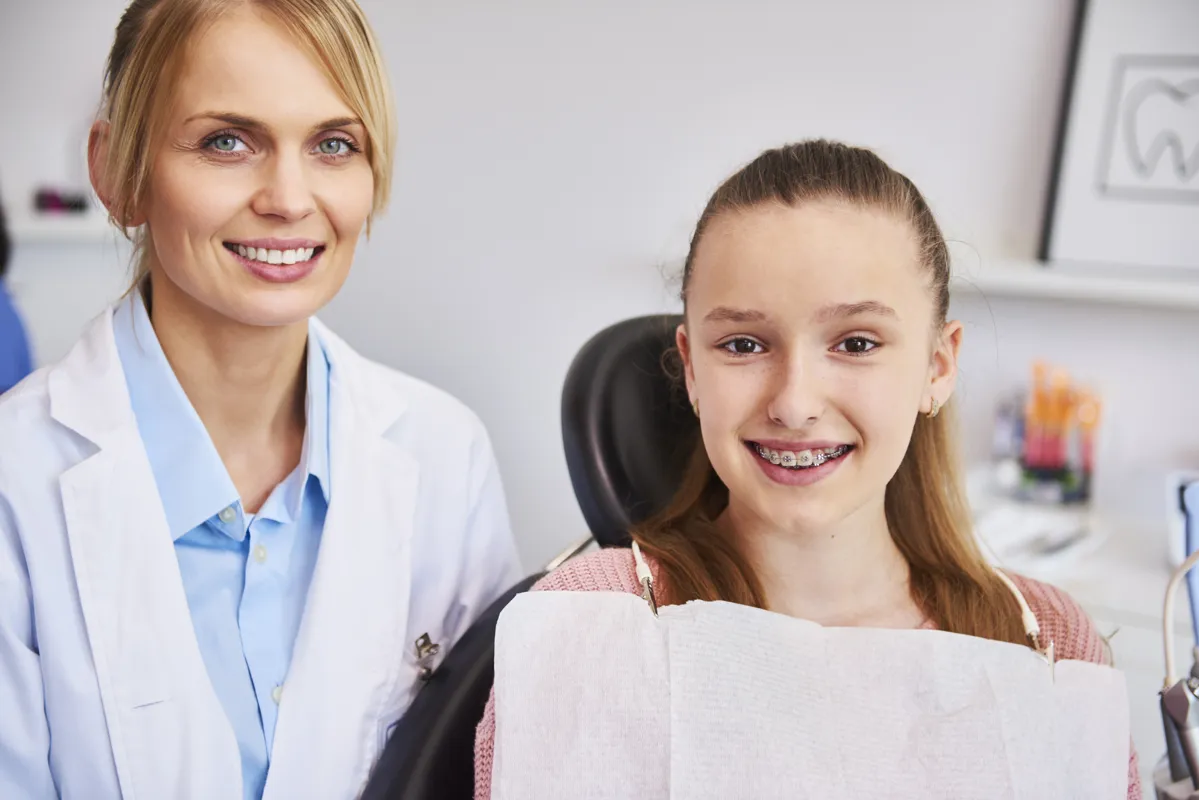
Children's orthodontics is the area of orthodontics that follows the development of the teeth and jaws in growing children, spots problems early and, where needed, guides development in the right direction. Jaws that are out of position in any of the three dimensions can be treated with orthopaedic appliances while growth continues; once growth has finished, the same effect is much harder to achieve. This page explains what to look out for in your child's mouth and what can be done at each stage.
Why a first orthodontic examination at age 7?
At around age 7 the first permanent molars have come through, the baby teeth at the front have started to fall out and the permanent incisors are erupting. At this stage a Specialist Orthodontist can assess the position of the upper and lower jaws relative to each other, the space available for the teeth, the bite, whether there is a crossbite, and whether any teeth are missing or extra.
Many people know that orthodontic treatment in children commonly starts at around 11 or 12, and a great deal of treatment is indeed done at that age. The recommended approach, however, is for a child's first orthodontic examination to take place when the baby teeth start to fall out, around age 7. This examination does not mean every child will start treatment straight away. For most children the outcome is simply monitoring. The real value of the examination is not missing the relatively few situations where early intervention genuinely makes a difference.
Signs to notice early
If you notice any of the following, there is no need to wait until age 7 for an orthodontic assessment:
- Baby teeth falling out very early or very late.
- The lower front teeth sitting in front of the upper front teeth when your child closes their mouth.
- On one side at the back, the upper teeth closing inside the lower teeth, with the jaw shifting to one side.
- A gap between the front teeth even when the mouth is closed.
- Upper front teeth that stick out noticeably.
- Constant mouth breathing, snoring, or lips that do not close at rest.
- Thumb sucking or dummy use continuing beyond the age of 4 or 5.
- Difficulty biting and chewing, or difficulty making certain sounds.
- Permanent teeth that are crowded or overlapping as they come through.
What is early (interceptive) orthodontics?
Interceptive orthodontics is treatment carried out during the mixed dentition stage, when baby teeth and permanent teeth are present together, to stop a developing problem from progressing or to reduce its severity. In children with tooth and jaw problems, early intervention with simple orthodontic appliances can make the problem less severe and help avoid more difficult treatment later.
The aim of early intervention is usually not to finish all treatment early. In many children a short course of early treatment is followed by a rest and monitoring period, and a second phase may be needed once the permanent teeth are complete. In most cases, though, that second phase is shorter and simpler. The main situations where early intervention is useful are:
- Crossbite at the back: Widening a narrow upper jaw can prevent the lower jaw from shifting to one side.
- Crossbite at the front: A single tooth biting the wrong way round can be corrected before it causes gum and enamel damage.
- Class III tendency: Where the upper jaw is behind, orthopaedic treatment during growth can be effective.
- Markedly protruding upper teeth: These teeth are exposed to injury and at higher risk of breaking; early correction can reduce that risk.
- Habit-related open bite: Once the habit stops, the teeth may partly correct themselves.
- Lack of space and risk of impaction: Planned removal of baby teeth that block the eruption path, or gaining space, can help permanent teeth come through in the right place.
Orthopaedic and functional appliances
Some of the appliances used in children's orthodontics target the development of the jawbones rather than the teeth. That is why they are called "orthopaedic", and they can only be effective while growth is still under way.
Upper jaw expansion appliances
In a narrow upper jaw, the growth line in the middle of the palate is used to widen the upper jaw sideways. The appliance can be fixed or removable. Fixed versions are attached to the back teeth and turned at set intervals by a parent with a small key. The orthodontist decides how many turns are made and how often. A temporary gap opening between the upper front teeth during expansion is expected.
Functional appliances
In Class II problems, where the lower jaw is behind, these appliances hold the lower jaw in a forward position to support its growth. Removable types must be worn for most of the day, especially at night. How well they work depends largely on how consistently the child wears the appliance and on the timing of the growth spurt.
Face masks and extraoral appliances
In children with a Class III tendency where the upper jaw is behind, a mask that rests on the face can be used to guide the upper jaw forward; it is mostly worn at home and at night. In some Class II cases, extraoral appliances that restrain the forward growth of the upper jaw may be preferred. Which of these appliances is used, when and for how long is decided by analysing the records, above all the cephalometric X-ray.
Habit-breaking appliances
Where habits such as thumb sucking or tongue thrusting continue and the child finds them hard to stop, an appliance placed against the palate that physically makes the habit more difficult can be used. These appliances are not a punishment; they should be used with the child's cooperation, after explaining to them what the appliance is for.
Harmful habits
Thumb sucking and dummies
Sucking a thumb or a dummy is natural in infancy. The problem arises when the habit continues towards the end of the baby-tooth stage and into the period when permanent teeth erupt. Prolonged, intense sucking can lead to an open bite at the front, upper teeth pushed forward, a narrowed upper jaw and crossbite. If the habit stops early, some of these changes can correct themselves. To help a child stop, it usually works better to notice when the habit appears (before sleep, in front of the television, when bored) and find alternatives for those moments than to blame the child.
Mouth breathing
Because of a blocked nose, enlarged adenoids or tonsils, allergic rhinitis or similar causes, a child may breathe through the mouth all the time. When the mouth stays open, the tongue rests low and does not support the upper jaw from the sides; over time a narrow, high palate, crossbite and a long face shape can develop. Sleeping with the mouth open, snoring, a dry mouth in the morning and lips that are always slightly apart are signs to watch for. These children may need an ear, nose and throat (ENT) assessment alongside orthodontic treatment; corrections made without resolving the breathing problem may not last.
Tongue thrust and lip habits
Pushing the tongue between the front teeth when swallowing can keep an open bite going. Sucking or biting the lower lip behind the upper teeth can push the upper teeth forward and the lower teeth back. Nail biting and pen chewing can also cause problems for the teeth and their biting edges.
Early loss of baby teeth and space maintainers
Baby teeth are there not only for chewing but also to hold space for the permanent tooth developing beneath them. When a baby molar is lost early because of decay or injury, the neighbouring teeth can drift into the gap. In particular, the first permanent molar behind it tilts forward and narrows the space. The permanent tooth coming up underneath then either cannot find room and erupts out of line, or stays impacted.
Space maintainers are used to prevent this. A space maintainer is a simple appliance that keeps the gap left by the lost baby tooth open until the permanent tooth comes through. It can be fixed, in the form of a band on the neighbouring tooth with a wire extending from it, or, where several teeth are lost, a removable plate. Whether a space maintainer is needed depends on which tooth was lost, the child's age and when the permanent tooth underneath is expected to erupt. The space maintainer is removed once the permanent tooth starts to come through.
The most effective space maintainer is the baby tooth itself. That is why treating decay in baby teeth matters; decay left untreated because "it will fall out anyway" can affect the alignment of the permanent teeth too. Baby teeth can also receive fillings and, where necessary, root canal treatment.
An age-by-age guide for parents
| Age | What is happening in the mouth | What to watch for as a parent |
|---|---|---|
| 0–3 years | Baby teeth erupt | Start cleaning the teeth as soon as the first one appears; avoid falling asleep with a bottle and sugary drinks at night |
| 3–6 years | The baby teeth are complete | Aim to stop thumb sucking and dummy use during this period; watch for mouth breathing and snoring; regular dental check-ups |
| 6–8 years | First permanent molars and front incisors erupt | First orthodontic examination; crossbite, front teeth biting the wrong way round and open bite are checked |
| 8–10 years | Mixed dentition continues | Early intervention and orthopaedic treatment if needed; assessment for space maintainers where baby molars have been lost |
| 10–13 years | Canines and premolars erupt, the growth spurt begins | May be a suitable period for functional treatment of jaw discrepancies; eruption of the canines is monitored |
| 12 years and over | The permanent teeth are largely complete | Comprehensive treatment with fixed braces, or clear aligners in suitable cases, if needed |
The ages in the table are general ranges. The timing of tooth eruption can vary by a year or two between children; on its own this is not a sign of a problem.
How does the treatment process work?
- Getting to know each other and the examination: The first visit is kept as calm as possible so the child can be examined without fear. The mouth is examined, and habits and breathing are asked about.
- Records: If needed, panoramic and cephalometric X-rays, photographs and impressions are taken.
- Decision: One of three routes is recommended: monitoring, early intervention, or waiting until the permanent teeth are complete.
- Treatment: If early intervention is needed, the appliance is made and its use is shown in detail to both the child and the parent.
- Monitoring: Even after active treatment ends, check-ups continue at intervals until growth and tooth eruption are complete.
The length of early intervention varies with the problem. Some treatments, such as correcting a crossbite, can be completed within a few months, while treatment aimed at guiding growth may take a year or longer. As with any orthodontic care, planning requires an in-person examination, and families should be able to attend regular follow-up visits in Ankara throughout treatment and the monitoring period.
Your child's cooperation
With removable appliances, the result depends largely on whether the child actually wears the appliance. To help with cooperation:
- Explain what the appliance does in words your child can understand.
- Link wearing times to the daily routine: after school, during homework, while sleeping.
- Build the habit of putting the appliance in its case at mealtimes; appliances wrapped in a napkin easily end up in the bin.
- Changes in speech and extra saliva in the first days are normal and usually pass within a few days.
- Clean the appliance with a brush and cold water; hot water can distort the plastic.
Possible side effects and things to watch
- A feeling of pressure, temporary changes in speech and extra saliva in the first days.
- Food collecting around fixed appliances, with a risk of decay if cleaning is inadequate.
- If an appliance pokes or comes loose, let the polyclinic know.
- Without cooperation, treatment may not have the expected effect, or it may take longer.
Common mistakes
- Not having decay in baby teeth treated because "they will fall out anyway".
- Postponing the first orthodontic examination until all the permanent teeth have come through.
- Treating long-standing mouth breathing and snoring as unimportant.
- Trying to stop a thumb-sucking habit by scolding the child.
- Having the child wear a removable appliance only "when someone remembers".
- Stopping monitoring check-ups once early treatment is over.
Children's orthodontics at Yetkindent
At our polyclinic, orthodontic examinations and treatment for children are carried out by Specialist Orthodontist Dr. Zeynep Yetkin, who completed her orthodontic specialty training at Selçuk University. Paediatric dental care such as the treatment of decay in baby teeth is also provided at the polyclinic. We are at YDA Center in Çankaya, Ankara, close to Çukurambar and Söğütözü, and are also open on Saturdays, which makes it easier to plan check-ups without clashing with the school timetable. For fixed treatment in older children and teenagers, see our dental braces page; for all the problems orthodontics covers, see our orthodontic treatment page. We address misconceptions that parents often hear in our article on orthodontic myths and facts.
You can contact the polyclinic to arrange an examination and assessment.
Frequently Asked Questions
When should I take my child to an orthodontist?
A first orthodontic examination is generally recommended at around age 7, when the first permanent molars have come through. If you notice something such as the front teeth biting the wrong way round, marked protrusion or the jaw shifting to one side, you can come earlier.
Does every child examined at 7 start treatment?
No. For most children the outcome of the examination is simply monitoring. Treatment is limited to situations where early intervention will genuinely help.
If my child has early treatment, will they still need braces later?
Some children may not; others need a second phase once the permanent teeth are complete. In most cases the aim of early intervention is to make that second phase shorter and simpler.
Does thumb sucking permanently damage the teeth?
Intense thumb sucking that continues into the period when the permanent teeth erupt can lead to an open bite and protruding teeth. If the habit stops early, some of the changes can correct themselves; if it continues, an assessment is needed.
What should I do if a baby tooth was removed early?
Especially when baby molars are lost early, the neighbouring teeth can drift into the gap. It is advisable to come for an examination soon after the extraction so the need for a space maintainer can be assessed.
Do orthopaedic appliances affect a child's speech?
With removable appliances there may be a temporary change in speech during the first days. Children usually adapt quickly.
Is orthodontics enough on its own for a child who breathes through the mouth?
Not always. If the mouth breathing has a nasal or adenoid cause, an ear, nose and throat assessment may also be needed. Corrections made without resolving the breathing problem may not last.
This content is for information only and does not replace an examination or diagnosis. The treatment that suits you is decided together with your dentist after a clinical examination and any necessary tests.